
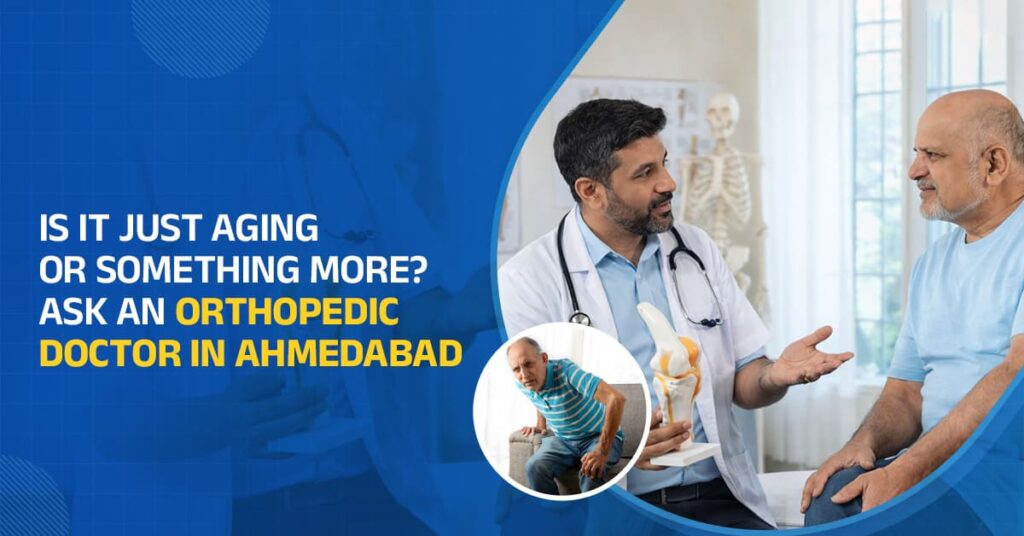
Is it Just Aging or Something More? Ask an Orthopedic Doctor in Ahmedabad
Ever caught yourself saying, “It’s just age,” when your knee clicks, your shoulder feels tight, or your back complains after a long day? Most of us do. We smile, stretch a bit, maybe apply some balm and move on. But here’s the encouraging part. Your body is not just aging; it is communicating. And when you listen early, act early, and get the right guidance, you can stay active, mobile, and comfortably in control for a long time. A little stiffness now and then is common. You sit through a long meeting, stand up, and your knee takes two seconds to cooperate. That is not a crisis. That is a signal. A signal means to pay attention, improve joint care, and give your body a bit more support than before. Aging is not a shutdown switch. It is a maintenance reminder. Think of how you treat your phone after two years. You do not throw it away. You update it, clear space, protect it better, maybe change the battery. Your joints deserve the same energy. Your Daily Life Already Gives You the Signals Joint health is not some complex mystery. It shows up in your routine. If you can walk to the market, climb a few flights of stairs, sit cross-legged sometimes, get up without much struggle, and sleep without pain waking you, your joints are doing a solid job. Celebrate that. Maintain that. If you notice small changes, such as taking the railing while climbing stairs, choosing lifts more often, or avoiding longer walks, that is not bad news. That is early news and useful news. It means you have time, options, and control. Many people only seek help when pain becomes loud. The smarter move is to act when discomfort is still soft. The Positive Truth About Modern Orthopedic Care Here is something uplifting and very real. Joint care today is far ahead of where it used to be. Treatments are more precise. Recovery plans are more personalised. Surgeries, when needed, are more advanced and more predictable than ever. An experienced orthopedic doctor does not just look at your X-ray and write medicines. They look at your lifestyle, movement, goals, and comfort level. The aim is not just to reduce pain. The aim is to restore function and confidence. Not Every Pain Means Something Serious Let’s keep this grounded and positive. Every ache is not dangerous. Sometimes it is just muscle weakness, posture issues, or overuse. For example, if you started morning walks after years of a sedentary routine and your knees feel sore, that is often adaptation, not damage. With the right exercises and guidance, your joints usually respond well. If you spend long hours at a desk and your shoulder feels tight, that often improves with posture correction and mobility work. Bodies are surprisingly forgiving when treated consistently and with respect. Small Changes Create Big Joint Wins Most people expect big treatments but ignore small habits. The small habits are where the magic hides. Simple strength exercises for thighs and hips support your knees. Regular stretching keeps joints mobile. Good footwear reduces unnecessary stress. Balanced weight reduces the load on the knee joints with every single step. Warm up before sports, cool down after. Old school advice, still gold. These are not complicated. They are powerful. Many orthopedic doctors now focus heavily on prevention and guided physiotherapy before any invasive treatment is discussed. That is good news for anyone who wants to stay active without drama. When Checking Early Becomes a Smart Move Seeing an orthopedic doctor is not a sign that something is terribly wrong. It is often just a smart checkpoint, like a joint health audit. People get their cars serviced before a long trip. Getting your joints checked when you notice repeated discomfort is the same logic. Sensible, not scary. A good consultation often gives clarity, like: What exactly is happening What stage is it in What you can improve naturally Which exercises help your specific case What to avoid so things do not worsen Clarity reduces fear. Direction builds confidence. Experience Brings Calm to the Process Patients feel more relaxed when they meet a doctor who has handled thousands of similar cases and explains things in simple language. In Ahmedabad, specialists like Dr Saurin Shah are known for this kind of practical, patient-friendly orthopedic approach, especially in knee and hip care. What patients often appreciate is not just technical skill, but a clear explanation. When a doctor shows you your report, explains what it means in plain terms, and lays out step-by-step options, decision-making becomes easier and lighter. It feels less like a medical maze and more like a guided path. Movement Is Still Your Best Friend One big myth needs a cheerful goodbye. Joint discomfort does not mean you should stop moving. In most guided cases, the right movement is the treatment. Controlled exercise nourishes joints. Muscles act like support staff for your bones. The stronger the support staff, the less pressure on the main structure. Walking, cycling, swimming, and supervised strength training are often recommended because they build support without excessive strain. Motion is lotion. Old line. Still true. Real Life Looks Better When Joints Feel Better Picture this. You get up from a chair smoothly. You climb stairs without planning every step. You travel without worrying about how far you must walk. You play with kids without calculating knee load. That is not a fantasy. That is the result of timely care and consistent joint habits. Orthopedic care is not about making you dependent. It is about making you capable again. Conclusion Aging is a privilege. Staying mobile as you age is a process. The project works best when you stay curious, proactive, and supported by the right expert when needed. If your joints have started sending repeated reminders, treat that as an invitation, not a warning. A conversation with a skilled orthopedic doctor in Ahmedabad can give you answers, options, and a practical plan to stay active.